Friday, May 28, 2010

28 May: Bike race

Yesterday evening we went into Durham to see the bike race. It was a short circuit of about a mile, with 10 teams of five riders hurtling round for over an hour.

Many people were watching by the nasty corner at the bottom of South Street -


- with a backdrop of the Castle.

At the top of the steep part, none of the riders were looking to their left, at the Cathedral across the river.


On the other side of the circuit, there were fewer spectators, but just as many barriers. This was the leading group, who lapped lots of the slower riders.


There were more crowds along the finish straight, by Durham School, although the PA was deafening.

The oldest rider won; if you want to see it all, it's on ITV4 tonight (Friday).

Monday, May 17, 2010

17 May: More knitting and weaving

This neckwarmer is knitted in a stitch shown to me by a fellow Guild member - but her instructions were in French, and it took a while to identify the same stitch with English instructions.


The yarn is handspun and home-dyed BFL, and both stitch and yarn are very good for a thick soft yummy scarf.

Back to the inkles. These two are plain weave, but with varied yarns. The broad one is some multi-colour scraps of merino, and the narrow one is Suffolk and BFL.


Two more pick-up patterns. It's a bit annoying to find a small mistake in the weaving on practically every band, but I suppose few of us are actually perfect....

Saturday, May 08, 2010

8 May: Playing with patterns

Pattern + colour = great fun.

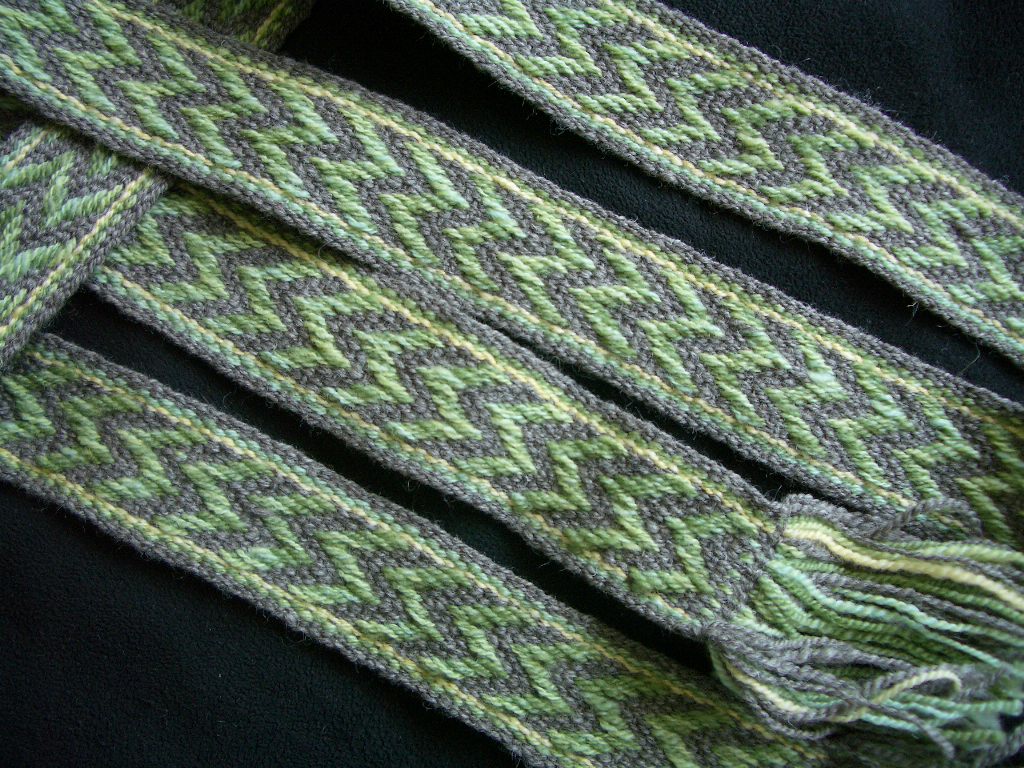
Next in the exploration of woven bands is this double chevron one -

woven in handspun Shetland yarns, 2 inches wide.

Then there's these 2 zigzag ones, different colour combinations but the same pattern -


Handspun yarns again, each band is an inch and a quarter wide. Both sides of all the bands are shown - the patterns are reversed on the back.

This next one, though only an inch and a half wide, needed a lot of threads, and the finest yarn in the stash is mill-spun. When used together with handspun, they seem to snag against each other - anyway, the weaving was "sticky", and the shed had to be coaxed open all the way along (including acres of unpicking and re-weaving.....);


but it's turned out very well, and the two small mistakes in the weaving aren't noticeable on the front. (It was only as the wrong side passed along under the loom that they became apparent - much too late to unpick.)

And then a first attempt at putting different patterns together - as a bit of light relief after the last one, they are all very easy patterns.


This one's got some sock yarn (home-dyed) along with the handspun Shetland and Black Wensleydale yarns, and it's an inch and a half wide. The photo doesn't show clearly that the striped border is yellow and brown, while the spotted border is green and brown.

Wednesday, May 05, 2010

5 May: Broken specs

This morning, as I sat down to browse the Interweb, I took my specs off - not needed for the computer - and they fell apart.

It looked as if the metal prongs holding the soft bit that goes over my nose had snapped away from the frame. I found my spare pair and wore them all day, thinking I would have to go and buy some new frames - an expense I wasn't planning on this month.

Then just now, when I'd hunted about and found my last prescription, I had another look at the broken specs, through the lenses of the spare pair, and spotted that there were tiny screws in the soft-bit-that-goes-over-my nose. The screws had simply come unscrewed! Half a minute with a tiny screwdriver, and I've just saved myself a few hundred pounds! I think I'll go and order some Shetland tops instead.

Friday, April 30, 2010

30 April: A cunning plan

There are now lots of inkles piled up in my playroom workroom.

So it seemed a good idea to make something from them. Like a bag. After fiddling about with ways of constructing a bag without having to hem too many ends, I worked out a sort of spiral, which forms a lop-sided tube; still needed to join the long sides together, and several ways of finishing the ends were considered before I chose to hem the narrow end at the bottom, and finish the top end by passing the cut threads through the weaving and braiding them on the front.

I had to cut the narrow inkle and stitch it to make the loops, though.


The bag is about 8" wide and 7" high with the top folded over. And at last I found a use for a boxwood acorn cut off a roller blind over 30 years ago - I knew it would come in handy one day!

The idea is that the sash will be simply knotted round me, and the bag is big enough for the essentials, while the clip can take keys if needed. The sash could also be knotted shorter, to make it a shoulder-bag or an across-the-body bag. Will the theory work out in practice?

Friday, April 23, 2010

23 April: Inkling on

- which sounds like something P.G.Wodehouse might have written.

The guild library last week yielded a small book called "Inkle Weaving" by Lavinia Bradley. It has a slightly different approach from my other books on the topic. One was to use up all those short bits of yarn that get thrown into a bag as too big to throw away, but too small to make anything with. They are simply knotted together and used to warp up the inkle loom - the knots get woven into the band, and an interesting texture and colour results -

The chapter titled "Bolivian Pebble Weave" looked interesting. The technique is illustrated by a typically South American Navajo design (!), which I wove in handspun BFL .

The suggestion in the book was that the technique could be adapted to produce more English designs like Christmas trees, horses and dogs.

I tried making up a meander-type design, but I don't think it's successful, either in the sugared-almond colours of BFL, or in the sludge colours of sock yarn -


Then, using the "Baltic-style" warping (one thick pattern thread followed by two thin background threads), I wove some handspun Shetland into a chevron pattern inkle which I love -


To make the pattern threads thicker, I needed 2 strands of yarn; as there was only one ball of each colour, I put a blue strand and a green strand together. It was dead easy to weave, the yarn was good to work with, and the finished band is very satisfying. There may be more.

(What do I mean, "may"?)

Wednesday, April 21, 2010

21 April: Wednesday Walk in Hamsterley Forest

Bright and sunny, though still a bit chilly, today, so off we went to Hamsterley Forest for one of our regular walks.

This tree looked as if it was draped with velvet -


- and this plant growing strongly beside the path surprised us -


I think it's skunk cabbage, but it's not listed in my usual handbook of British wild flowers, so I'm not really sure.

Down by the river, many of the trees have had the ground eroded away from around their roots -


The river itself was quiet today, as was the Forest - we saw only a few people, and those mostly in the car park.

Sunday, April 18, 2010

18 April: Spring

The lawn has had its first cut of the year. Some flower seeds have been sown in pots and trays, and two or three plants that seem not to have survived the winter have been threatened - start putting out shoots, or go straight to the compost heap, do not pass Go, etc.

There's been time for some inkle weaving -

These are all in handspun wool, 3 plain weave bands and one, the green and yellow one in merino, a very time-consuming pick-up pattern which makes it the same on both sides.

That one was still in progress when I went to the Guild's monthly workshop day; out of less than a dozen people there, 3 of us were working on inkles! Must be something in the air (apart from volcanic ash, of course).

And a parcel of fibre came from Wingham Wool Works, some merino/tencel blend, some wool/linen blend, and 3 little Estonian wool batts. So far I have spun up one of the Estonian batts and a bit of the wool/linen, which is quite heavily textured - that's "lumpy" viewed from the other side. Not sure what they might be used for, perhaps an inkle or two?

But with the lighter evenings, archery has moved out of the sports halls and onto the playing fields. After shooting at 25 yards all winter, it's wonderful to have a target a hundred yards away. And this week the summer schedule starts, with shooting 3 times a week instead of twice.

Sunday, April 11, 2010

11 April: Inkle exploration

The low-tech weaving has shifted into inkle-weaving. (For those with no inkling about that, an inkle is a narrow woven band, in the shoe-lace to cummerbund width range.)


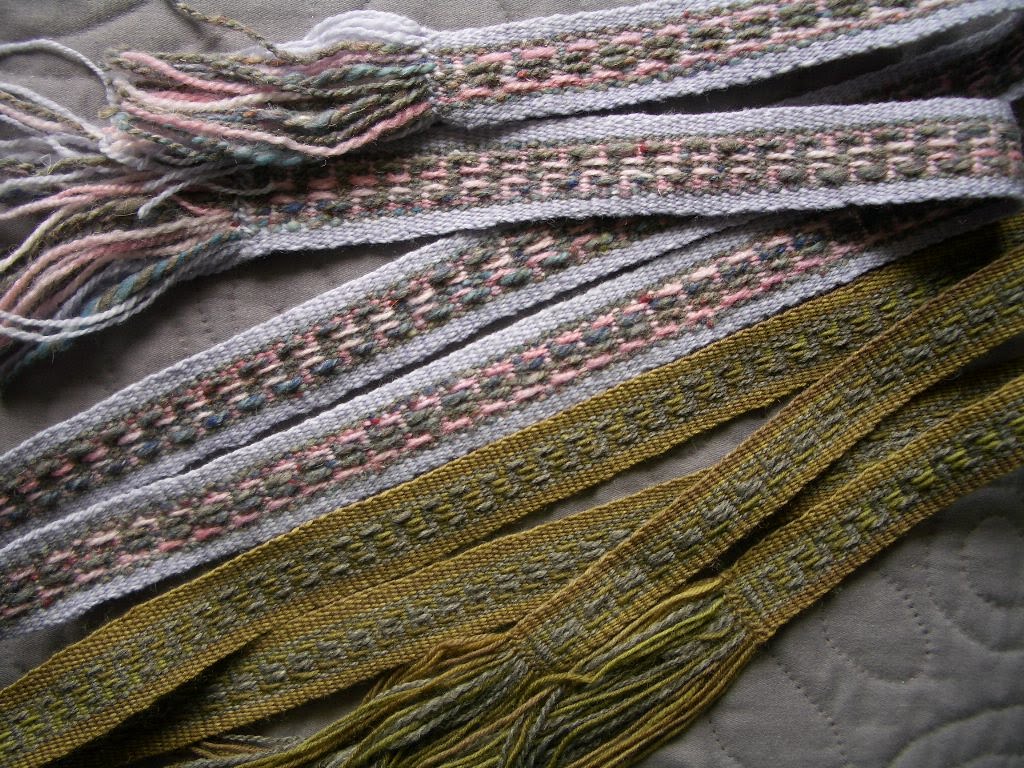
The pink and grey wool one at the top is woven to a design by Laverne at Backstrap Weaving - she took the pattern from a yurt band and wove it on her backstrap loom; my version was done on an inkle loom.

The lavender and gray interlaced pattern is another one woven in my handspun wool on the inkle loom.

The pile sample was woven on my backstrap loom, with a warp of handspun linen and pile knotted on in rug wool. Different spacings and pile lengths were explored, before I decided that life is probably too short to go any further with this. At least it shows it can be done on a backstrap loom.

The green and cream interlaced pattern one is done in cotton in 2 thicknesses. This pattern needed a lot of concentration, and even after unpicking several bits (and several times too!), there are mistakes in the weaving.

The bottom band is woven on the inkle loom in mill-spun Shetland wool (spun in Shetland), and was an attempt to finish up a bagful of leftover small skeins. The warp threads clung to each other, and opening every shed was an effort, but the finished band is worth it - lovely subtle colours and a solid feel, and at over 2 inches wide and 6 feet 3 inches long, a useful size. In fact I like it so much, I think I'll go and make another one.

Tuesday, April 06, 2010

6 April: Wednesday walk on Tuesday

Today we did something we'd spoken about idly several times since getting the Bus Passes - we took the bus from the end of our street, got off at a convenient place for coffee and a bun, then walked home. It took less than 2 and a half hours.

We managed to walk down one path we've never been along before, and found that another track through the woods has been repaired and a footbridge improved since we last came that way.

We walked through fields where skylarks were flying up on both sides, singing as they hung on the breeze. The bumble bees are just emerging this week, too, so spring is really under way.

Crossing this field, we wondered if we were missing something -


- but there was no invisible fence. It might have been a magic stile, the entrance to another world. We went round it, just in case.

Friday, April 02, 2010

2 April: Gardening begins


The event that really marks the start of the gardening season is -

digging out the compost bin!

Which was done this morning, much to the delight of one robin, who actually dared to come into the garden while I was there (very unusual for our local robins), and later on a varied selection of dunnocks, blackbirds, tits and chaffinches.

It is clear that eggshells don't biodegrade as quickly as expected, though the little red worms cluster round them even more thickly than other compost components - we seem to have a very healthy and growing population of little red worms.

The first primroses are coming out, yellow as well as purple, and the hellebores are doing well -


- and the miniature daffs are at their best -

Saturday, March 27, 2010

27 March: Shuttles!

This week has been a bit of a non-event, as I've been laid low with the lurgy; even stayed in bed one day. So there has not been a lot of fibre activity.

This afternoon, though, a couple of happy hours were spent in the garage, making 2 small shuttles. When my lovely large band shuttle arrived, it was packed between some bits of scrap wood, which then waited patiently in my work-room to be used for something. There was a nasty knot in one bit, but it was big enough to turn into 2 little shuttles.


I drew round the one that came with my inkle loom, and used a variety of tools, saw, chisel, hand drill, jigsaw, and lots of sandpaper. I'm ridiculously pleased with them.

Sunday, March 21, 2010

21 March: Still knitting

As well as the current interest in low-tech weaving, there is still knitting going on. This shawl has just been finished -


- and it was bright and (just) warm enough to take it into the garden to photograph.

It's knitted from a pattern in Traditional Knitted Lace Shawls by Martha Waterman, in my own handspun green merino/silk and grey wool/silk; as I had never knitted a half-circle shawl before, I wanted to see how the shaping worked. Also I wanted something to knit while watching TV, and to take to the Guild meetings, where talking takes priority over following a complicated pattern.

It's a nice shape and size - 50" across, 25" deep - enough to keep the back and shoulders warm without the long tails of a triangular shawl dangling in everything. Just right for a little old lady, and I'm none of those 3 things.

Monday, March 15, 2010

15 March: 2 new things before breakfast

Awake early, thinking about a weaving project, I started to think about some braids I'd seen on Laverne's blog. They looked a bit like Japanese kumihimo braids , and I had tried those a couple of times, so I had an idea how they might work.

Cut some strands of cotton and did a 4-strand braid, then got ambitious, and violà!* here's a multi-colour 6-strand braid as well.


You can see quite clearly where I started to get the hang of proper tension.

* Yes, I know it's really "voilà", but I saw this mis-spelling recently, and it amuses me.

Sunday, March 14, 2010

14 March: Family

After last week's roving mark, I decided to make some arrows that suited my light bow rather better. Well, not so much "make" as "assemble". All the bits came in the post from various suppliers, and hours were spent trimming and gluing. I tried them out - the bow-string needed a slight amendment, which was easily done - then spent some more happy hours painting them with odds and ends of paint found in the garage. At least I should be able to spot them in the grass!

Then most of today went in following up some recent family history research. At last I have found a trace of my Dad's "uncle who was a police officer", who appeared (with a tight collar and toothbrush moustache) at the back of a 1925 wedding photo. He had the same name as both his father and my Dad, and then the 1911 census revealed that he had given almost the same name to his son!

It was interesting to find that both a newly-discovered great-great-aunt and the wife of this newly-found great-uncle had the same first name as my Dear Grand-daughter.

Then this evening, just as I'd put the phone down from a nice long chat with my Dear Daughter, the door-bell rang, and my Dear Son was here for a nice long chat.

Monday, March 08, 2010

8 March: Roving mark

It was a glorious day yesterday for the first outdoor shoot of the season, a roving mark competition.

Here is a view of the shooting line; the previous target was the post with the banner on top, and the next target is a similar one some 100 to 150 yards away. Landing an arrow within a bow's length of the mark scored a point - landing an arrow in the mark scored 5 points.

Although we were shooting in a deer park, the herd kept well away, and no animals were inconvenienced in any way by our shooting. A good time was had by all, with a picnic on the grass at lunch time, followed by a second competition in the afternoon. Only 2 arrows stuck into trees, and one of those was (mostly) recovered.

A magic day - although I failed to trouble the scorer, I can't wait till the next one!

Thursday, March 04, 2010

4 March: More bits of weaving

When I made the inkle for the loom bag pocket, I enjoyed the process, so I made a few more.


The green and white one is handspun bamboo; the purple, blue, green and brown one is some cotton samples from Texere; the blue, turquoise and lavender one is crochet cotton; the charcoal, orange and blue one is handspun BFL/tencel; the coral and green one is Natural Dye Studio sock yarn in merino and bamboo; and the grey and pink one is handspun Shetland. They are all different in feel, and I love them all!

Then back to the backstrap loom for an experiment in sprang, something I'd been meaning to try for ages.

Brief instructions in a paragraph and 3 diagrams in a 1974 book, Off the Loom by Shirley Marein. Unfortunately, it forgot to mention that some of your earliest handspun wool yarn is perhaps not the best material to use for your first attempt. On the other hand, though, there was no need for sticks to hold the twist in the upper part of the work - the yarn stuck together by itself, very securely. Only really a problem when mistakes were made, and un-weaving had to be done. But that was more often than I would have wished.

And then, looking on the positive side again, that's the last scrap of the awful hairy Wensleydale used up (that's the bluish colour). This is how it looks relaxed -


- and this is how it looks spread out -


The instructions for finishing it off were vague, so I turned to my friend Google, who brought me straight to Phiala's String Page; where I discovered that my use of bamboo kebab skewers had already been thought of, and the method of closing the middle of the woven piece was one I had come across before in tri-loom weaving.

It is, of course, the ideal method for making a string bag.......

Sunday, February 28, 2010

28 February: Another sort of skein

At about a quarter part one this afternoon, a large skein of geese, perhaps 50 or 60, flew high over our house, honking gently and heading North.

There is colour at the tips of the crocus buds, in our garden and in the municipal roadside plantings.

But it's snowing again.

Friday, February 26, 2010

26 February: A project from the backstrap loom

The piece of weaving on the backstrap loom in the previous picture is now part of a finished bag - a bag to store my backstrap loom.


The front and back were made separately, the front having a white tencel warp and a green ramie weft, and the back having a green tencel warp and a white ramie weft. The tencel is wonderfully silky, and the ramie is much softer than the linen used for my bow bag.

A pocket for the front (to keep rubber bands and bits of string in) is 2 pieces of a strip woven from bamboo yarns on an inkle loom and joined together. The button loop is plaited bamboo yarns, and the hanging strap is plaited ramie.


All the yarns are my own handspun. The button is one of hundreds from my button box.

Sunday, February 21, 2010

20 February: More low tech

This week I have been mostly playing at weaving with a backstrap loom.

Some sticks and rubber bands, plus a couple of bits of string, made an improvised loom, on which was woven a backstrap. Lots was learnt from mistakes - crossing warps is not a good idea, nor is using soft cotton (probably only dishcloth cotton, but plenty of it in my stash).

Anyway, in spite of all that, the backstrap was made, and then a sample strip gave the chance to try out some variations, like twining, twill weave, and pile.

The current project is to weave a bag to keep the bits of stick, string, and rubber bands in, tidy and together. Here is a picture of work in progress (obviously without a body in the way) -


The body sits on the stool, with the orange backstrap round the back of the hips, and the loops on the ends round the large stick. As the fabric is woven, it is wound round the near stick and held in place with a dowel and rubber bands.

I went to the local old-fashioned ironmongers to buy a broom-handle. The assistant corrected me - a broom is very large, for sweeping yards, what I wanted was a brush-handle, a smaller item for sweeping indoors. I stood corrected, and paid my pound for a 4 foot long, 1 inch diameter stick.

That makes the 2 sturdy end bits; lengths of dowel help keep the warp in place. The lovely tool with the weft wound onto it is a large netting/band shuttle from Michael Williams, fine woodworker.

The warp in the photo is handspun tencel, and the weft is handspun ramie, one of the skeins dyed last week.

Full instructions for making your own backstrap loom can be found on WeaveZine. Yours doesn't have to be orange.