Showing posts with label inkle. Show all posts

Thursday, April 07, 2011

7 April: Two more bands

These little bands are quite addictive!  For the first of these two, I spun some dark navy and some cherry red from a parcel of lucky-dip mixed wool fibre from World of Wool. The design was adapted from a band by Laverne Waddington, which she got from a Russian band.


I thought there were no mistakes in the weaving until I turned the finished band over - and found a couple of misplaced warps which didn't show on the front.

But the second band has no weaving mistakes that I can see! It's one of the designs in Sue Foulkes' book Sami Band Weaving, and I love the asymmetric pattern. This one is done in handspun natural coloured wools (Shetland and "black" Wensleydale)  with an accent of dyed green Shetland.


There's a slight snag in that the pattern section, with its warp floats, is woven a little more tightly than the spotted border, so the band forms a gentle spiral.  Firm steam pressing will probably sort that out.

Now I really must get back to knitting the sock that was cast on a week ago.

Tuesday, March 29, 2011

29 March: Two very different woven bands

Filled with enthusiasm from the weekend workshop, I have  been weaving a couple of bands on my backstrap with rigid heddle.

First was a wide plain woven band, using some very textured early spinning, to see how wide a band the heddle would make. It came out 2.5 to 3 inches wide (variable tension control!), and 69 inches long.

Then one in finer yarns, crochet threads, in one of the patterns in Sue Foulkes' book about Sami band weaving; this is a pattern that looks good on both sides. This one is 47 inches long and 0.75 inches wide.

Here they are -


And Happy Birthday brother!

Friday, March 11, 2011

11 March: It'll be all right when it's pressed

That's what my mother used to say when her dress-making looked a bit rough and ready.  And it works for inkles too.

The light-bulb moment the other day was to make a bag to carry my collection of backstrap stuff in - the bag itself being made of inkles. The inkle strips sewn together looked very lumpy and uneven, but a few minutes with the steam iron resulted in a thick and even fabric.

A quick walk to the shops for a zip and a bit of ribbon  (to cover the raw edges inside), and hours of sewing, and here's the finished item with some of the kit to go in it -


And here it is with all that stuff inside. It's 22' long and 10.5" deep. I used inkles I had already made, 4 altogether, which were cut into 11 strips.  The zigzag inkle is just about long enough to go all the way round and make handles, and the zip pull is made with part of the band made the other day on my double hole rigid heddle (the other bit has been made into a bowsling for my recurve bow).

Wednesday, March 09, 2011

9 March: Another rigid heddle

This rigid heddle is made from a heddle intended for an Ashford Knitter's Loom - a 40 cm heddle cut in half. This gives the facility to use up to 59 threads, and the large holes will allow thick or lumpy (sorry, textured) threads to pass through.

This time I measured the warp before weaving, then measured the finished band and the amount of waste at each end. The chosen pattern was a simple 5 pattern thread design, but this time with rather more fancy borders. 57 threads altogether, came out just over 2 inches wide.


The advantage of the rigid heddles over the inkle loom is that you can start warping in the middle, and then add borders afterwards, and it's much easier to change threads when warping than on the inkle loom.  Plus, of course, the length can be anything you want, as long as you can keep the warp tidy. On the down side, tension is more variable, and wastage is more.

There's quite a few pieces added to the backstrap kit now, and the original bag is not big enough for them all. The need for a larger bag could be tied in with the large number of woven bands hanging over the cupboard door. Perhaps another light-bulb moment?

Sunday, August 08, 2010

8 August: The Saltholme bags

This project started back on 27 June, when Guild members were demonstrating spinning at the RSPB place at Saltholme - they have a small flock of Shetland sheep keeping the grass short, and it was shearing day.

I returned from there with a black Shetland fleece, a black Hebridean fleece, and half a grey Shetland fleece. (To add to the 2 Shetland fleeces bought from Woolfest.) My fibre preparation skills have had a good deal of practice since then!

The grey Shetland and the black Hebridean produced some tough yarn, so weaving seemed best.The warps were arranged in groups, black at the edges, then 4 grey alternating with 4 black, then a middle section of 2 grey alternating with 2 black. 3 separate sections were woven, the first one with black and grey wefts in varying groups; one with an inch of black weft alternating with 3 inches of weft in a multi-colour wool/linen yarn; and the 3rd section with a weft consisting of one strand of black together with one strand of grey.

The first 2 sections have now been made up into bags -


The straps are the same yarns woven on the inkle loom, in a tweedy stripe for the black and grey bag, and in an interwoven pattern for the multi-coloured one - this inkle has a narrow stripe of the multi-coloured wool/linen yarn between the border and the central pattern.

Both bags are lined with home-dyed cotton fabric from the quilting stash - purple for the black and grey bag, and green for the multi-colour one. Hand-stitched.

The button box yielded a suitable large button for a closure for the black and grey bag, but a search of the Durham shops had to be undertaken for the black horn bead that forms the closure on the multi-colour one.

They will have an outing to Gateshead next month, as part of a Guild exhibition.

Saturday, July 24, 2010

24 July: Catching up

Recent projects have mostly been rather uninteresting to photograph - spinning fleece mostly, but there have been a few small items now rounded up into a picture -


There are some inkle bands - two narrow ones done on the old loom, and the green/blue one done on the new moon loom. The ball of off-white yarn is spun from an Estonian batt from Wingham at Woolfest (I spun that one evening when bored with Le Tour), the dull purple sock yarn is from the Yarn Yard - a plain sock in progress for my Dear Husband - and the beaded row counters were made very quickly, after seeing something about them on Ravelry, and finding the instructions on eHow; I tried out various wooden and glass beads, and several different types of yarn.

Then yesterday I was reorganising my archery stuff, and decided to make a cloth bag for my recurve bow, so that I can carry it in one piece, rather than keep on taking it to bits and re-assembling it every time I use it. The piece of fabric in the box that was large enough also happens to be bright red, and made of microfibre. It is, therefore, very tough. It had also been in the fabric box for about 25 years, since I bought it in Peterlee when I was working over there.

Anyway, last time the sewing machine was used, there was a problem with the tension, so I decided to sew this by hand. It was hard work, but at least there's the feeling that it's done satisfactorily.The tie is a narrow inkle band, originally an experiment for shoelaces, but I failed to get the ends narrow enough to thread them through the lace-holes. Still, it's just right for this purpose!


One and a half fleeces have been spun, and some of the resulting yarn has been woven and is now waiting to be made up into the planned bags - more experiments.

Monday, July 05, 2010

5 July: The new inkle loom

Last night it had to be done - try out the new inkle loom, made by Michael Williams and collected from the Woolfest.

The yarn is a ball of merino/tencel sock yarn from the stash which will never be socks, and which will probably make a very nice little woven pouch. There are 71 warp threads , and plenty of width left for a wider band. Not all the pegs are used for this band.


I find it's a bit high to work at when it's on the table, but it will fit on my lap, resting against the table at the back, and that is very comfortable. The warp is moved on quite easily; the shed is not as wide (high?) as on my Ashford inkle loom, but I expect I'll get used to that.

So now there's a weaving project started, as well as 2 knitting projects, and a Hebridean fleece partly spun. And Le Tour has started. What a good thing I don't have to go out to work any more!

Monday, June 28, 2010

28 June: Lake District part 2 - Woolfest

One of the reasons for our week in the Lake District was to visit Woolfest for a little stocking up on fibre and fibre-related items.


I collected my new inkle loom from Michael Williams - isn't it gorgeous? Really substantial, made from oak and maple.

There is the usual assortment of sock yarn, undyed and dyed from the Yarn Yard (I wound it into balls when we got home), some batts and "wild fibre" from Wingham, and some plain white fibre from P & M to blend it into, a lucet with bobbin from Ziggy Rytka (who was later spotted playing a hurdy-gurdy in the music area), a circular knitting needle, some buttons, and a book.

Oh, and 2 Shetland fleeces, straight from the sheep-owner. After my adverse experience with fleece when a novice spinner, I have avoided it and used prepared fibres, but these fleeces are so lovely that I decided it was time to have another try.

Then yesterday I was demonstrating spinning at an event which included sheep-shearing, and seem to have come home with a further 2 and a half fleeces - the half because 2 of us liked that particular grey colour. The grey and one black one are Shetland and the other black one is Hebridean.

The rest of today I shall be in the garden, combing and spinning fleece.

Sunday, June 06, 2010

6 June: Back to the wool

A few more inkle bands have been woven - here are two of them in use securing my carders -


Recent spinning has included a bag of wool/linen , which was not very easy to spin, but which has an interesting texture. It has now been dyed and wound into balls, ready for making into something or other.


More spinning, this time a bag of Jamieson and Smith's Shetland fibre in a range of 14 different shades. About 25 gms in each little skein, about 20 w.p.i.

And then yesterday was spent demonstrating spinning with the Guild at a local Medieval Fair - a sure sign of summer. Unfortunately, I have no photos.

Monday, May 17, 2010

17 May: More knitting and weaving

This neckwarmer is knitted in a stitch shown to me by a fellow Guild member - but her instructions were in French, and it took a while to identify the same stitch with English instructions.


The yarn is handspun and home-dyed BFL, and both stitch and yarn are very good for a thick soft yummy scarf.

Back to the inkles. These two are plain weave, but with varied yarns. The broad one is some multi-colour scraps of merino, and the narrow one is Suffolk and BFL.


Two more pick-up patterns. It's a bit annoying to find a small mistake in the weaving on practically every band, but I suppose few of us are actually perfect....

Saturday, May 08, 2010

8 May: Playing with patterns

Pattern + colour = great fun.

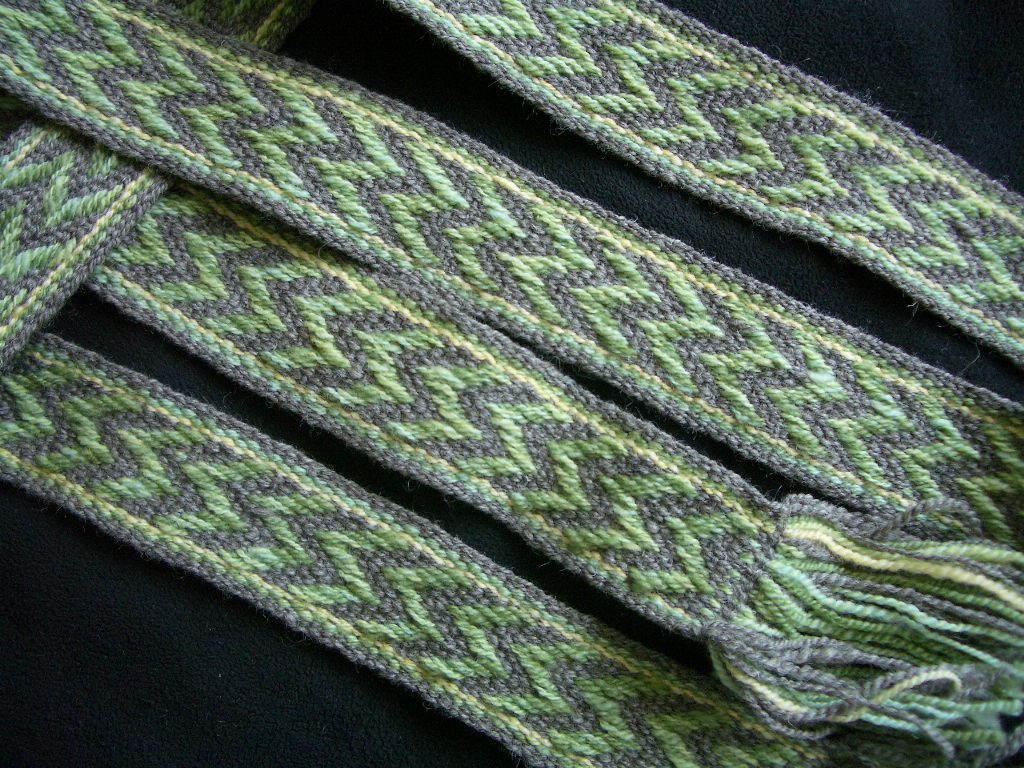
Next in the exploration of woven bands is this double chevron one -

woven in handspun Shetland yarns, 2 inches wide.

Then there's these 2 zigzag ones, different colour combinations but the same pattern -


Handspun yarns again, each band is an inch and a quarter wide. Both sides of all the bands are shown - the patterns are reversed on the back.

This next one, though only an inch and a half wide, needed a lot of threads, and the finest yarn in the stash is mill-spun. When used together with handspun, they seem to snag against each other - anyway, the weaving was "sticky", and the shed had to be coaxed open all the way along (including acres of unpicking and re-weaving.....);


but it's turned out very well, and the two small mistakes in the weaving aren't noticeable on the front. (It was only as the wrong side passed along under the loom that they became apparent - much too late to unpick.)

And then a first attempt at putting different patterns together - as a bit of light relief after the last one, they are all very easy patterns.


This one's got some sock yarn (home-dyed) along with the handspun Shetland and Black Wensleydale yarns, and it's an inch and a half wide. The photo doesn't show clearly that the striped border is yellow and brown, while the spotted border is green and brown.

Friday, April 30, 2010

30 April: A cunning plan

There are now lots of inkles piled up in my playroom workroom.

So it seemed a good idea to make something from them. Like a bag. After fiddling about with ways of constructing a bag without having to hem too many ends, I worked out a sort of spiral, which forms a lop-sided tube; still needed to join the long sides together, and several ways of finishing the ends were considered before I chose to hem the narrow end at the bottom, and finish the top end by passing the cut threads through the weaving and braiding them on the front.

I had to cut the narrow inkle and stitch it to make the loops, though.


The bag is about 8" wide and 7" high with the top folded over. And at last I found a use for a boxwood acorn cut off a roller blind over 30 years ago - I knew it would come in handy one day!

The idea is that the sash will be simply knotted round me, and the bag is big enough for the essentials, while the clip can take keys if needed. The sash could also be knotted shorter, to make it a shoulder-bag or an across-the-body bag. Will the theory work out in practice?

Friday, April 23, 2010

23 April: Inkling on

- which sounds like something P.G.Wodehouse might have written.

The guild library last week yielded a small book called "Inkle Weaving" by Lavinia Bradley. It has a slightly different approach from my other books on the topic. One was to use up all those short bits of yarn that get thrown into a bag as too big to throw away, but too small to make anything with. They are simply knotted together and used to warp up the inkle loom - the knots get woven into the band, and an interesting texture and colour results -

The chapter titled "Bolivian Pebble Weave" looked interesting. The technique is illustrated by a typically South American Navajo design (!), which I wove in handspun BFL .

The suggestion in the book was that the technique could be adapted to produce more English designs like Christmas trees, horses and dogs.

I tried making up a meander-type design, but I don't think it's successful, either in the sugared-almond colours of BFL, or in the sludge colours of sock yarn -


Then, using the "Baltic-style" warping (one thick pattern thread followed by two thin background threads), I wove some handspun Shetland into a chevron pattern inkle which I love -


To make the pattern threads thicker, I needed 2 strands of yarn; as there was only one ball of each colour, I put a blue strand and a green strand together. It was dead easy to weave, the yarn was good to work with, and the finished band is very satisfying. There may be more.

(What do I mean, "may"?)

Sunday, April 18, 2010

18 April: Spring

The lawn has had its first cut of the year. Some flower seeds have been sown in pots and trays, and two or three plants that seem not to have survived the winter have been threatened - start putting out shoots, or go straight to the compost heap, do not pass Go, etc.

There's been time for some inkle weaving -

These are all in handspun wool, 3 plain weave bands and one, the green and yellow one in merino, a very time-consuming pick-up pattern which makes it the same on both sides.

That one was still in progress when I went to the Guild's monthly workshop day; out of less than a dozen people there, 3 of us were working on inkles! Must be something in the air (apart from volcanic ash, of course).

And a parcel of fibre came from Wingham Wool Works, some merino/tencel blend, some wool/linen blend, and 3 little Estonian wool batts. So far I have spun up one of the Estonian batts and a bit of the wool/linen, which is quite heavily textured - that's "lumpy" viewed from the other side. Not sure what they might be used for, perhaps an inkle or two?

But with the lighter evenings, archery has moved out of the sports halls and onto the playing fields. After shooting at 25 yards all winter, it's wonderful to have a target a hundred yards away. And this week the summer schedule starts, with shooting 3 times a week instead of twice.

Sunday, April 11, 2010

11 April: Inkle exploration

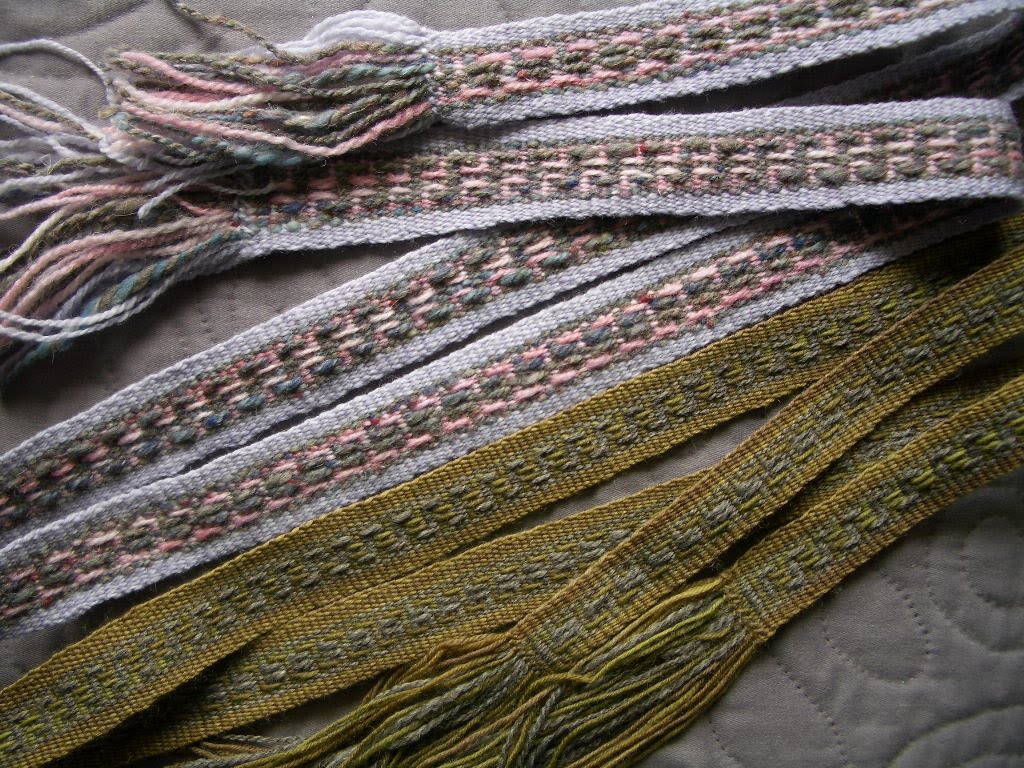
The low-tech weaving has shifted into inkle-weaving. (For those with no inkling about that, an inkle is a narrow woven band, in the shoe-lace to cummerbund width range.)


The pink and grey wool one at the top is woven to a design by Laverne at Backstrap Weaving - she took the pattern from a yurt band and wove it on her backstrap loom; my version was done on an inkle loom.

The lavender and gray interlaced pattern is another one woven in my handspun wool on the inkle loom.

The pile sample was woven on my backstrap loom, with a warp of handspun linen and pile knotted on in rug wool. Different spacings and pile lengths were explored, before I decided that life is probably too short to go any further with this. At least it shows it can be done on a backstrap loom.

The green and cream interlaced pattern one is done in cotton in 2 thicknesses. This pattern needed a lot of concentration, and even after unpicking several bits (and several times too!), there are mistakes in the weaving.

The bottom band is woven on the inkle loom in mill-spun Shetland wool (spun in Shetland), and was an attempt to finish up a bagful of leftover small skeins. The warp threads clung to each other, and opening every shed was an effort, but the finished band is worth it - lovely subtle colours and a solid feel, and at over 2 inches wide and 6 feet 3 inches long, a useful size. In fact I like it so much, I think I'll go and make another one.

Thursday, March 04, 2010

4 March: More bits of weaving

When I made the inkle for the loom bag pocket, I enjoyed the process, so I made a few more.


The green and white one is handspun bamboo; the purple, blue, green and brown one is some cotton samples from Texere; the blue, turquoise and lavender one is crochet cotton; the charcoal, orange and blue one is handspun BFL/tencel; the coral and green one is Natural Dye Studio sock yarn in merino and bamboo; and the grey and pink one is handspun Shetland. They are all different in feel, and I love them all!

Then back to the backstrap loom for an experiment in sprang, something I'd been meaning to try for ages.

Brief instructions in a paragraph and 3 diagrams in a 1974 book, Off the Loom by Shirley Marein. Unfortunately, it forgot to mention that some of your earliest handspun wool yarn is perhaps not the best material to use for your first attempt. On the other hand, though, there was no need for sticks to hold the twist in the upper part of the work - the yarn stuck together by itself, very securely. Only really a problem when mistakes were made, and un-weaving had to be done. But that was more often than I would have wished.

And then, looking on the positive side again, that's the last scrap of the awful hairy Wensleydale used up (that's the bluish colour). This is how it looks relaxed -


- and this is how it looks spread out -


The instructions for finishing it off were vague, so I turned to my friend Google, who brought me straight to Phiala's String Page; where I discovered that my use of bamboo kebab skewers had already been thought of, and the method of closing the middle of the woven piece was one I had come across before in tri-loom weaving.

It is, of course, the ideal method for making a string bag.......